Communication is not merely a professional skill. It is a human responsibility. It shapes relationships, institutions, governance, and the future of nations.
Corporate Leadership & Communication Summit 2026
The Toastmasters Corporate Leadership & Communication Summit, Ethiopian Edition, was held on May 9, 2026, at Hilton Addis Ababa, bringing together senior executives, policymakers, entrepreneurs, communication professionals, and members of Toastmasters International for a high-level dialogue on leadership and communication in Ethiopia’s evolving corporate landscape.
Organized by Toastmasters members in Ethiopia, the summit convened distinguished speakers and thought leaders to explore how effective communication shapes leadership impact, organizational culture, and institutional performance. The event featured keynote addresses, executive panels, interactive discussions, and experiential learning sessions designed to bridge corporate leadership practice with communication excellence.
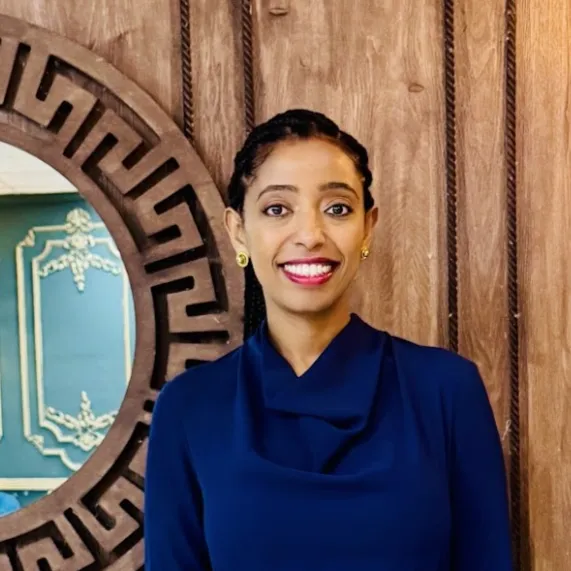
One of the highlights of the summit was the opening address by Her Excellency (H.E.) Wro. Meaza Ashenafi, Former Chief Justice of the Federal Supreme Court of Ethiopia, who delivered a powerful reflection on the role of communication in leadership, institutional reform, trust-building, and national development. Her remarks deeply resonated with participants and set the tone for the summit’s overarching message: that communication is not only a professional skill, but a foundation of leadership and societal transformation.
The following is the speech delivered in full at the summit.
![][image15]
Toastmasters Corporate Leadership & Communication Summit Speech by H.E. Meaza Ashenafi (Former Chief Justice of Ethiopia)
Venue: Hilton Hotel, Addis Ababa | Date: Saturday, May 9, 2026
Address by H.E. Wro. Meaza Ashenafi
Distinguished Guests, Leaders from the Corporate Sector, Members of Toastmasters International, Ladies and Gentlemen, Good morning.
Let me begin by congratulating Toastmasters for your remarkable achievements both nationally and globally. Over decades, Toastmasters has empowered individuals to find their voice, sharpen their confidence, and transform communication into leadership. In a world increasingly defined by noise, polarization, and speed, organizations like Toastmasters are not merely training speakers you are nurturing leaders.
The subject of today’s summit Corporate Leadership and Communication is very close to my heart.
Throughout my professional journey as a lawyer, institution builder, activist, and public servant, I have witnessed first-hand the transformative power of communication. I have seen how communication can build institutions, inspire reform, mobilize communities, resolve conflict, and restore trust. I have also seen how the absence of communication creates confusion, alienation, mistrust, and institutional weakness.
This topic is relevant everywhere in the world, but perhaps even more relevant in our country today.
Ethiopia stands at a critical moment in its history. We aspire to economic transformation, stronger institutions, private sector growth, innovation, and global competitiveness. We have made significant progress in private sector development and we have even bigger ambitions ahead of us. But sustainable economic growth cannot flourish in an environment of misunderstanding,
![][image16]
mistrust, and instability. Peace and stability are essential for the flourishing of the private sector, and communication plays a central role in building both.
Communication is Leadership
Communication is leadership.
Especially in this age of constant noise, communication requires clarity. Leaders who communicate with clarity cut through confusion. They provide direction when others are uncertain. They reduce fear and build confidence.
But communication is not only about clarity. It is also about connection. And connection happens when communication is authentic.
When we connect authentically, we build trust. Trust builds teams. Teams build institutions. And institutions sustain nations.
There is also an important distinction between leadership communication and management communication.
Management communication focuses on process, coordination, systems, and efficiency. It ensures that work gets done.
Leadership communication, however, inspires. It creates a collective vision. It mobilizes people emotionally and intellectually toward a shared purpose.
Both are important.
An institution cannot survive on inspiration alone, and it cannot thrive on procedure alone.
Communication is also deeply connected to organizational culture.
When I was appointed to lead the Ethiopian judiciary, one of the things that surprised me was the almost nonexistent communication between judges, court clerks, and administrative staff. People worked in silos. Many did not feel empowered to communicate openly across professional hierarchies.
We began to change this culture intentionally by example, by training, and by encouraging respectful interaction across all levels of the institution. Slowly, communication became part of institutional reform.
![][image17]
Because communication is not only about speaking.
Communication is also about transparency and respect.
At one point in my career, I encountered a staff member who rarely responded to emails. When asked why, he simply said: “I am working on it. I do not see the need for communication.”
But communication itself is part of the work.
Silence, neglect, and lack of responsiveness create anxiety and inefficiency within institutions.
I also remember a televised interview given many years ago by a government minister. The journalist asked the first question, and the minister continued speaking for almost an hour without allowing any meaningful interaction or engagement.
It was frustrating to watch.
Communication is not a monologue. It is an exchange. True communication requires awareness, sensitivity, and respect for the audience. Sometimes leaders speak to impress rather than to connect. That disconnect often comes from either ignorance or ego.
In both politics and business, communication is currency.
In politics, whoever reaches the emotions of the people often shapes public opinion.
In the corporate world, communication frequently determines success.
A friend of mine who worked at Bank of America once told me that bank clerks were trained on how many times they should respectfully call a customer by name during a short transaction. There was even a manual for it.
Why?
Because institutions understand that respect communicated consistently creates loyalty and trust.
![][image18]
Of course, communication must be supported by knowledge and skill.
And yet one of our greatest challenges is that communication is rarely treated as a serious field of study despite its enormous impact on leadership and productivity. Warren Buffett once said that communication skills can increase the value of an employee by 50 percent. I believe that is true.
The Gender Dimension and Active Listening
Communication also has a gender dimension.
Women are often socialized to be empathetic, accommodating, and consensus builders. These are valuable qualities. But sometimes this socialization also causes women to hold back their voices in professional environments.
I have seen situations where women introduce excellent ideas in meetings, only for someone else to repeat the same idea later and receive the recognition.
Communication is also about active listening.
We all know individuals who begin preparing their response before the other person has even finished speaking.
But genuine communication requires listening with empathy and care. Sometimes people do not need immediate answers; they need to feel heard. Communication also requires courage.
When I served as Director of the Ethiopian Women Lawyers Association, I gave a long media interview about a woman who had suffered severe violence. The government at the time was unhappy with my statements. I was pressured to retract them.
I refused.
Soon after, our organization was suspended.
![][image19]
But we did not succumb to fear. We took the Ministry of Justice to court, and we won. Our organization was reinstated.
That was a historic moment.
It reminded me that communication is not only about persuasion; sometimes it is about principled courage.
Communication is also about feedback, both giving it and receiving it.
And at the institutional level, communication requires organization. Too much unsystematic communication can create chaos just as much as too little communication can create isolation.
And sometimes silence itself is communication.
There are moments when restraint carries more wisdom than words. Ladies and Gentlemen,
A Journey of Impact
Communication is multifaceted, and I do not claim to be an expert in this field.
But I know with certainty that authentic communication has enabled me to inspire vision, build teams, reform institutions, and connect with people across different sectors and generations.
When my colleagues and I founded the Ethiopian Women Lawyers Association, there were not even established Amharic terms for concepts such as violence against women or sexual harassment. We helped coin words like “ጥቃት” and “ወሲባዊ ትንኮሳ,” and through persistent communication and advocacy, these concepts became part of public discourse, law, and policy.
When we established Enat Bank, we did not begin with a sophisticated strategy document. People followed stories. People connected emotionally and authentically to the vision.
When we established Enat Bank, we did not begin with a sophisticated strategy document. People followed stories. People connected emotionally and authentically to the vision.
And when I was appointed Chief Justice, the Supreme Court did not even have an institutional logo, functioning email system, website, or social media presence. Some people questioned why such things even mattered.
![][image20]
But once those communication systems were established, the public image and accessibility of the institution improved significantly. At the Federal Supreme Court of Ethiopia, we learned that effective leadership communication is not only about speeches or public image, it is also about institutional clarity. In addition to strengthening the image and public trust of the Court, we issued more than 35 directives to guide both internal and external relations and define institutional roles and responsibilities. This helped transform the organization from one that often operated on assumptions and informal norms into one guided by clear rules, accountability, and shared understanding.
Even after leaving office, I continue to communicate nationally, regionally, and internationally sharing my journey, engaging with younger generations, and contributing to conversations on justice, leadership, peace, and women’s empowerment.
And honestly, that remains one of the greatest sources of my fulfillment. Ladies and Gentlemen,
So let us continue to communicate with clarity, authenticity, empathy, and courage.
Because clarity guides. Authenticity builds trust. And courage inspires."